
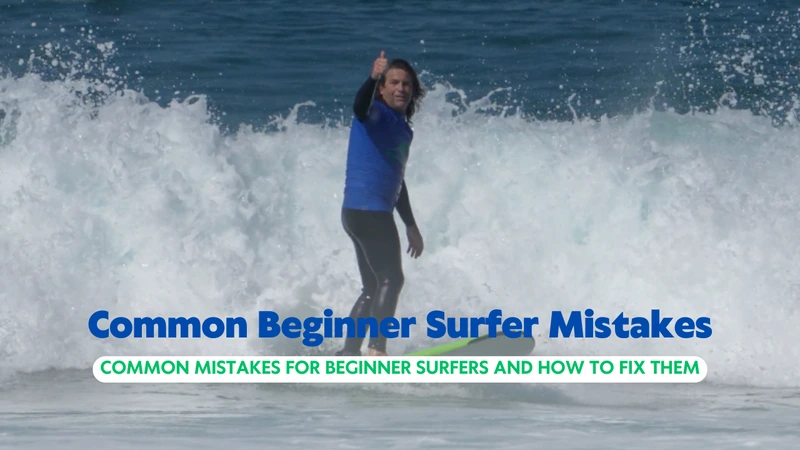
If you’re planning a trip to Lisbon and want to learn to surf, it’s important to know that learning to surf is exciting, challenging, and incredibly rewarding. Yet, most beginner surfers struggle with the same common mistakes and this mistakes slow down your progress, increase frustration, and sometimes make surfing feel harder than it needs to be.
As surf coaches at Breakthrough Surf School in Costa da Caparica, we teach plenty of new surfers every year. We’ve seen the same issues appear again and again, and we know exactly how to fix them. This guide breaks down the most common mistakes for beginner surfers and how to fix them so you can improve faster, stay safe, and build solid technique that will serve you well as you progress your surfing.
1. Putting Your Knees on the Surfboard During the Pop-Up (and Other Pop-Up Mistakes)
The Problem
One of the most common beginner surfer mistakes is placing the knees on the surfboard when trying to pop up. This slows the takeoff, destabilises the surfboard, and creates a habit that becomes very hard to break later. Other mistakes include placing your hands too far forward or too wide on the rail of the surfboard, looking down at the surfboard and feet, not putting your back foot first, or popping up with your feet too close together.
How to Fix It
The full and detailed technique is explained in our guide Best Way to Pop Up and Take Off on a Surfboard for Beginners and here is the breakdown of the Common pop-up mistakes and how to correct them.
Here is the list that you should go through:
- Placing your knee on the surfboard
- Hanging your head outside the surfboard
- Hanging your hips outside the surfboard
- Knees and feet pointing in opposite directions
- Arms pointing in opposite directions
- Not using your arms to point where you’re going
- Looking down at your feet or surfboard
- Uneven weight distribution
- Placing feet too close together
But in short the pop up the pop up steps are:
- Place your hands under your chest.
- Push your upper body up in one smooth movement.
- Bring your back foot directly under your body by rotating your body (leg, hips, shoulders) to the side of your back foot in one motion. This rotation of the body allows you to create space between you and the board and to place the foot fully planted on the surfboard without touching the knees on the board.
- Place your front foot between your hands at the same time take your hands of the surfboard.
- Look forward, not down.
- Point forward with your body and both hands
- Keep your body and head weight inside the surfboard bounds as putting your weight outside the surfboard will cause you to fall or be stuck in an difficult position.
Practising the correct pop-up technique early prevents bad habits that become very difficult to change later.
Here are a few more common beginner surfer mistakes:
2. Not Looking Over Your Shoulder When Paddling for a Wave
The Problem
When beginners start catching waves by themselves, they often paddle without checking what the wave is doing behind them. They keep their back turned to the wave, hoping it will simply “pick them up.” This leads to bad takeoffs, being caught off-guard, or missing the wave entirely.
How to Fix It
Always look over your shoulder and keep an eye on the wave when paddling for a wave. You need to know:
- Where the wave is.
- How fast it’s approaching.
- Whether it is steepening or flattening.
- Whether you need to adjust your position on the board, paddle harder or paddle slower.
- Whether someone is already taking the wave or not.
This awareness is essential for correct timing. If you never look back, you will eventually automate that behaviour and later it becomes much harder to correct.
So, build the habit from day one: check the wave, understand what it’s doing, and adjust accordingly.
3. Paddling With Both Arms at the Same Time
The Problem
Another classic beginner surfer mistake is paddling with both arms or hands simultaneously, in a “double-arm” motion. This makes the board stop and start, reduces speed, wobbles the surfboard causing it to stop gliding and makes catching waves much harder.
How to Fix It
Explicamos a técnica correta de remada no nosso guia How to Paddle on a Surfboard for Beginner Surfers, mas em resumo:
- Paddle with alternating arms, one after the other, in a smooth, continuous cycle.
- Keep your chest up and your head looking forward.
- Pull deep with each stroke without over extending your arms.
- Keep your body stable and avoid rocking the surfboard side to side.
Correct paddling technique builds speed, improves balance, makes you less tired by having to put in less effort in paddling, and makes catching wave much easier.
Why Fixing These Surfing Mistakes Early Matters
Surfing is a sport of muscle memory, whatever you repeat becomes automatic, whether it’s good technique or bad technique. Many beginner surfers unintentionally practise mistakes simply because they are easier at the start or because they don’t know a better technique. The problem is that once a movement becomes automatic, changing it later requires much more effort.
By learning the correct fundamentals early, proper pop-up technique, looking over your shoulder, efficient paddling, and so on, you build a solid foundation that will make your surfing smoother, safer, more enjoyable and more able to progress to the next level.
Final Tips for Beginner Surfers
- Practise slowly and correctly before trying to move fast.
- Film your surf sessions or take a surf lesson so you can see and correct mistakes.
- Be patient, good habits take time and repetition.
- Focus on technique, not just on catching more waves … but don’t forget to have fun surfing!
Surf Better, Learn Faster at Breakthrough Surf School
If you want personalised coaching to fix your technique and avoid common beginner mistakes, join us for surf lessons in Nova Praia, Costa da Caparica near Lisbon.
We specialise in helping beginner surfers build strong fundamentals from day one. And yes, we also do surf rentals for when you feel ready to try surfing on your own here in Caparica!
See you at the beach!

Leave a Reply